
Touch Screen Integration

Touch-Screen

In conference rooms, auditoriums, and other applications, it is sometimes desired to integrate Avi-on lighting controls with a touch screen for simplified end user controls, and to integrate lighting with other Audio visual elements.

Due to the wide range of applications, existing systems, and applications, Avi-on does not manufacture a dedicated touch screen device. Avi-on does, however, offer several methods to easily integrate Avi-on controls into other control systems and touch screen products.

This document outlines the methods and recommended applications for each method.

RS-232 Serial INterface

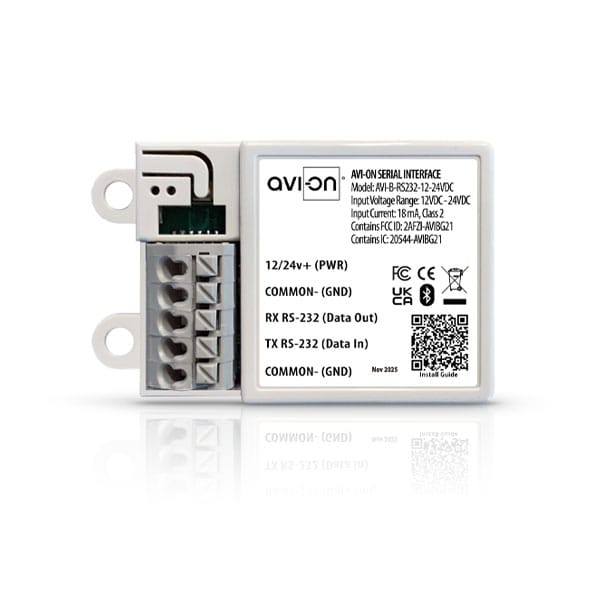
Sensor Input ModuleThe Avi-on RS-232 Serial Interface provides a reliable, two-way serial connection to touch-screen control units or any device that needs to send or receive commands to/from the Avi-on Network using the Avi-on Serial ASCII Protocol.The Avi-on Serial Protocol supports a wide range of external interface control actions, including:
  • Send to the Avi-on Network: Device/Group ON/OFF/Dim Level commands, Scene Triggers, Dimming Overrides, Avi-on Lockdown Mode triggers, and UL 924 Mode triggers.
  • Receive from the Avi-on Network: Device/Group dimming status updates, sensor trigger information, and Lockdown Mode enable/disable notifications.
  • Design custom touch-screen interfaces with ease by sending the appropriate serial commands from your preferred touch-screen or building control system.
  • The complete command set, along with sample integrations for common control systems—including Crestron and RTI—is provided in the installation guide. On/Off of individual devices

Contact Closure Input

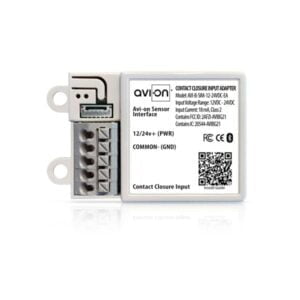
Sensor Input ModuleUsing the AVI-B-SIM-12-24VDC-EA, a contact input from another control system or touch screen product can trigger a wide variety of functions within the Avi-on system. The SIM is a low cost, 12-24DC powered device that can be placed anywhere within Avi-on BLE Network range of the controlled devices (70ft min). The interface operates fully locally without the need for gateways or internet. Control functions include:
  • On/Off of individual devices
  • On/Off of Groups of devices
  • On/Off of Scenes
  • On for a specific time duration, including bi level dimming
  • Override default motion based control for a period of time
PRO TIP: One contact closure input device is needed per control action. An unlimited number of SIM’s can be used.

BACNet INTEGRATION

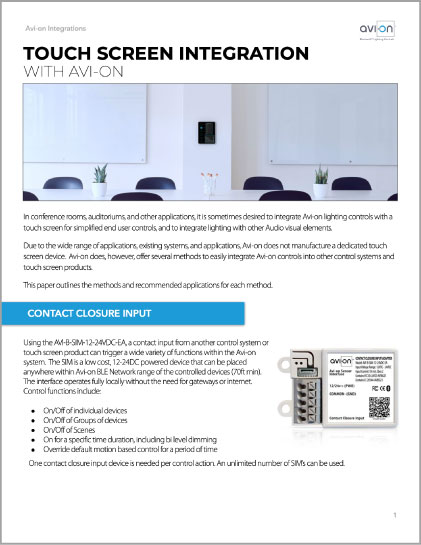
BACnet LinkThe Avi-on BACNet Link (AVI-BACnet-LINK) allows any number of devices, groups, or scenes to be controlled within a facility using a single BACNet IP link. The BACNet link can be placed anywhere inside the facility that has good connection to the Avi-on BLE Network. The BACNet Link can also report back the dimming status of devices in the room and sensor triggers. The Link operates fully inside the building without the need for other gateways or internet. Control Functions Include:
  • On/Off/Specified Dim Level of individual devices
  • On/Off/Specified Dim Level of Groups of devices
  • On/Off of Scenes

Visual Floor Plan Control

Avi-on has recently released a web based control capability to turn devices and rooms on and off from a floorplan based web browser interface. To control an area, the user uses the web browser interface to navigate to the area they want to control. The browser is managed by the Avi-on cloud to allow control from any location. An Avi-on RAB LTE is required to connect the local Avi-on BLE network to the Avi-on cloud. Both LTE and Ethernet connectivity are supported.
Deployment is simple. Using the Visual Floor Plan editor, simply import the desired floor plan layout and mark the areas to be controlled in each space.
Visual Floor Plan Control platform is newly released and has an expanding roadmap of features. The following capabilities are currently supported:

  • On/Off/Dim Level for Devices and Spaces (Entire Rooms)
  • Multiple floor plans can be configured within the interface
PRO TIP: Currently all floorplans are visible to users for a given project location.

Pros and Cons of Each Option and Recommendations

Solution Recommended Applications Advantages Disadvantage

RS-232 Serial Interface

  • Touch screens and AV systems requiring two-way serial communication
  • Legacy or specialized building control systems that use ASCII serial control
  • Custom UI projects where integrators send real-time lighting commands
  • Full two-way communication (send and receive)
  • Supports full Avi-on command set
  • Simple ASCII protocol for fast, flexible custom integrations
  • Ideal for Crestron, RTI, and traditional serial-based control processors
  • Requires systems capable of RS-232 output/input
  • Not suitable for long-run wiring without signal boosters
  • Requires the integrator to manage command formatting and programming

SIM Contact Closure

  • Small number of integration points, system connections that only support contact interface
  • Universal Interface
  • Local Control
  • Low Cost Per Unit
  • Pre programmed dim levels only
  • Not ideal for very large numbers of controlled points

BACNet Link

  • Large number of controlled points
  • Interfacing to HVAC controls
  • Unlimited control points
  • Dimming as well as On Off
  • Industry Standard Interface
  • Higher cost for small installations
  • Dependency on local IP Network

Visual Floorplan

  • When a standard computer is the preferred/only interface
  • Acceptable to control all configured floorplans
  • Web Based, Location Independent
  • Runs on any web browser interface
  • Dimming and On OFF
  • Requires active internet connection and login to web pages
  • New product with limited capabilities
  • Scenes not currently supported but on the roadmap

Download this Document

Touch Screen Integration